
When is the best time for tree trimming outdoors?
Plants from different genus and species require different maintenance techniques. Tree trimming is best saved for certain seasons depending on the plant.
Read more →
Staking, cabling, and bracing for structural integrity
Trees sometimes need additional support to manage structural weaknesses, prevent failure, or establish proper form. Our certified arborists design and install support systems that reduce risk while minimizing impact on tree health and aesthetics. We follow industry standards for all installations.
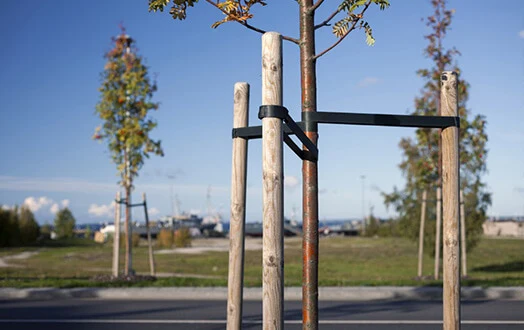
Newly planted trees often require temporary staking to establish proper root anchorage. We use proper staking techniques that allow natural trunk movement while preventing uprooting, promoting strong trunk development and root establishment.
Flexible steel cables installed high in the canopy provide supplemental support for weak unions, co-dominant stems, or overextended limbs. Cabling reduces stress on weak points while allowing natural tree movement and growth.
Rigid bracing systems use threaded rods to provide stronger support for severe structural weaknesses. Installed through the trunk or major limbs, bracing prevents splitting and failure of compromised unions while maintaining tree viability.
Most newly planted trees benefit from staking for one to two growing seasons. We install stakes below the lowest branches using flexible ties that allow controlled movement. This movement promotes trunk taper and root development while preventing the tree from uprooting or leaning.
Common staking mistakes include staking too high, using materials that don't allow movement, or leaving stakes in place too long. Our team ensures proper installation and provides guidance on when stakes should be removed.
We install flexible steel cables according to ANSI A300 standards. Cables are typically placed at approximately two-thirds the height between the weak union and the branch tips. We use proper hardware including eye bolts, cable clamps, and thimbles to create secure, long-lasting installations.
Cable systems require periodic inspection to ensure hardware remains secure and cables maintain proper tension. We offer maintenance plans that include regular inspection and adjustment as needed.
Bracing involves installing threaded rods through weak unions to provide rigid support. This technique is used when cabling alone isn't sufficient or when unions have already begun to split. Our arborists carefully size and install braces to maximize support while minimizing tree damage.
Brace installation is an invasive procedure that requires drilling through living tissue. We take great care to work during appropriate seasons, apply proper wound treatment, and monitor trees post-installation to ensure they're responding well.
Every tree and situation is unique. Our certified arborists assess the tree's structure, the severity of weaknesses, the tree's value, and the potential target if failure occurs. Based on this assessment, we design appropriate support systems that balance effectiveness, cost, and tree health.
Support systems require regular inspection. Cables can loosen over time, hardware may corrode, and tree growth can affect system performance. We recommend annual inspections for cabled or braced trees. During inspections, we check hardware integrity, cable tension, and tree response, making adjustments as needed to maintain effectiveness.
Support systems reduce but don't eliminate failure risk. They're designed to help trees withstand normal weather conditions, not extreme events. In some cases, removal may be a safer alternative than attempting to support a severely compromised tree. Our arborists provide honest assessments and help you make informed decisions about your trees.
Contact our certified arborists for a structural assessment and support system recommendations.
Call 631-467-7999